
Mostrando entradas con la etiqueta landscape. Mostrar todas las entradas
Mostrando entradas con la etiqueta landscape. Mostrar todas las entradas

TIMELAPSE - FROM ALGERIA WITH LOVE
Sahara Wonderland from zoomion on Vimeo.
For more information and download please visit: http://www.zoomion.ch/sahara-wonderland/
Follow me on facebook:
http://www.facebook.com/zoomion
Music is from:
SaReGaMa http://saregama-music.blogspot.com/
Video and music is licensed by CC-NC-SA
http://creativecommons.org/licenses/by-nc-sa/3.0/
TIMELAPSE - MOROCCO
Morocco from Stian Rekdal on Vimeo.
BEST VIEWED IN FULLSCREEN HD - SCALING OFF
In september of 2011 I spent 2 weeks travelling around Morocco covering over 3200km (2000 miles). It was my first visit to this beautiful country, but it will definetly not be the last.
Locations include: Marrakesh, Ait Ben Haddou, Dades Gorge, Erg Chebbi, Fez, Meknes, Chefchaouen, El Jadida, Essaouira and Legzira beach.
Equipment:
Dynamic Perception Stage Zero Dolly - http://www.dynamicperception.com/
Nikon D700
Nikon D7000
Nikon 14-24mm F2.8 G ED AF-S
Nikon 50mm F1.4G AF-S
Sigma 24-70mm F2.8 IF EX DG HSM
Nikon 18-105mm F3-5-5-6G ED VR AF-S DX
Software:
Adobe After Effects
Adobe Photoshop
Adobe Lightroom
LRTimelapse
GBDeflicker
Photomatix Pro
SNS HDR Pro
Topaz Adjust 4
Nik Color Efex Pro 4
Next Stop: Tenerife & La Gomera!
PHOTOGRAPHY - VERONICA AZARYAN - 2ND PART
A review of Veronica Azaryan photography. She done a great quality process of Tunisian Architecture. She done it with a minimal sintesis. I apreciate her work cause it's really hard to process an African country in that way so abstract. It give new ways for design and process African Landscapes outside figurative & representative photography.


PHOTOGRAPHY - VERONICA AZARYAN - 1ST PART
A review of Veronica Azaryan photography. She done a great quality process of Tunisian Architecture. She done it with a minimal sintesis. I apreciate her work cause it's really hard to process an African country in that way so abstract. It give new ways for design and process African Landscapes outside figurative & representative photography.


Art breaks down invisible border
The steel fence that slices the United States - Mexico border now has a small, "invisible" gap in it. Quiroz bolted a digital vinyl photograph, spanning 12 feet high and 60 feet wide, to the wall to give the illusion that the wall isn't there - so people standing on the Mexico side can see right into the U.S.
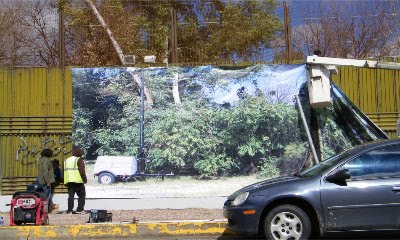
“We placed it on the border wall in Mexico and basically it’s a photograph of exactly what’s on the other side,” Quiroz said. “In other words, making the wall somewhat invisible.” The photo is located on the main street along the border about a half a mile west of the border crossing in Nogales, Sonora Mexico. Quiroz and his team installed the picture on Feb. 9 by lining up the image with the surrounding background, and bolting it into the steel.
“The border patrol doesn’t allow anybody to put anything on the wall on the American side,” Quiroz said. “Whereas on the Mexican side, the Mayor gave us carte blanche, we can do whatever we want.”
“(The Mayor) said ‘it's not our wall. We didn’t put it up. Do whatever you want,’” Quiroz said. “So we have literally thought of the border wall as becoming a gallery.”
In fact, the entire project was funded by Mexican cultural organizations.
“The border patrol doesn’t allow anybody to put anything on the wall on the American side,” Quiroz said. “Whereas on the Mexican side, the Mayor gave us carte blanche, we can do whatever we want.”
“(The Mayor) said ‘it's not our wall. We didn’t put it up. Do whatever you want,’” Quiroz said. “So we have literally thought of the border wall as becoming a gallery.”
In fact, the entire project was funded by Mexican cultural organizations.
Border Art - Paseo de la humanidad
This sculpture mounted on the wall is supposed to depict the 2 sides of the border, the people moving across it and what they bring with them. The highly symbolic figures are based on ancient mesoamerican pictograms where people are depicted with icons floating above their heads to indicate who they are.
this art is by Alberto Morackis and Guadalupe Serrano.
this art is by Alberto Morackis and Guadalupe Serrano.

This installation was oriented towards the deaths of migrants in the desert and the humanity of the migration phenomenon. In this piece, the figures are depicted by images from the borderlands. Fruits, vegetables, bombs, the Statue of Liberty, and household appliances all help to build the images of other figures as they represent society on the border.

These giants were constructed from post-industrial maquiladora material, an aspect of their identity that complicates their interpretation. Are they pushing the wall down? Are they holding the wall up? Who are they?

Pictogram - Complete Catalog online !!!
A new publication about pictogram works. The complete catalog of srceen printing.
"European borders / African misery", screen printing, 2011, 30 x 40 cm
http://www.ziadzitoun.com/
"European borders / African misery", screen printing, 2011, 30 x 40 cm
A theme about North African revolution and European borders. With a process of pictogram as simple visual arts elements, Ziad Zitoun create aesthetic of contemporary realities of African deportation due of a hard European migrant politic.
Thematics of inspiration revolves around rights of migrants, trans-borders movements & refugee Asylum. Ziad Zitoun gives thoughts on the South-North relations and be testimonies of persons who live without dignity, without fundamental rights (health, work, education). The author studies related social problems and it transcribe it in contemporary art domain for create aesthetic of migration.
Thematics of inspiration revolves around rights of migrants, trans-borders movements & refugee Asylum. Ziad Zitoun gives thoughts on the South-North relations and be testimonies of persons who live without dignity, without fundamental rights (health, work, education). The author studies related social problems and it transcribe it in contemporary art domain for create aesthetic of migration.
http://www.ziadzitoun.com/
XAVIER RIBAS - PHOTOGRAPHY
From Concrete Geographies I
“We thought the network society and informational capitalism was seamless, but we see more of these crude and cruel stitches than before, where the haves and have-nots are brutally kept apart. The walls of Ceuta, Palestine, Tijuana prove that our world is not a smooth corporate network society but a striated space of fortresses, enclaves and capsules"
Lieven de Cauter, A Cyberpunk Landscape: Snapshots of the ‘Mad Max Phase' of Globalization (2008)

The two Spanish enclaves of Ceuta and Melilla on the Mediterranean coast of North Africa date back to the 15th Century, when Ceuta in 1415 and Melilla in 1497 were seized from Morocco by Portugal and Spain. Ceuta later became Spanish territory on the signing of a treaty with Portugal in 1668. Since the decolonization of Morocco by France and Spain in 1956 and the problematic handing over of the Sahara territories under Spanish rule in 1975, the situation of the two enclaves has remained an unresolved colonial issue. Spain claims that Ceuta and Melilla were never part of the colonial protectorate because they were already an integral part of Spanish territory long before. Morocco, however, insists that the two cities are in Morocco and surrounded by Moroccan territory. This dispute became even more pertinent when Spain entered the EC in 1986 (later EU), making of Ceuta and Melilla the only EU territories outside Europe. Suddenly, these two EU territorial borders in mainland Africa, which had been quite fluid and permeable for decades while they were only national borders, became the most direct way for African migrants to enter the EU without crossing the sea.
The fencing of the two Spanish cities to stop unauthorized crossings into EU territory started in 1993. In 2005 the fences were raised from three to six metres high, and equipped with sound, movement and heat sensors, surveillance cameras and razor wire. This technology allows the Spanish patrols to efficiently monitor each border from a central surveillance room, in contrast to the Moroccan army which, funded by the EU, has set numerous military posts along the fences to invigilate the southern approach to borders it doesn’t even recognize as legitimate, but sees as a residue of colonial impositions.
Ceuta and Melilla are contested territories inscribed with a specific history of military occupation and protected by overtly racialized boundaries. This ‘border of borders’ defines at once a colonial/national boundary between Spain and Morocco, an economic boundary between Europe and Africa, a geopolitical boundary between North and South, and a religious boundary between Christianity and Islam. From the time of the Spanish Reconquista Ceuta and Melilla were mostly military outposts for territorial expansion. Since the creation of the EU, however, they have become militarized borders of contraction*. In its desire to expand to new territories, or to withdraw from them, Western capitalism has always managed to increase the gap between centre and periphery, between affluence and poverty. It has created increasing rates of exclusion, and as a consequence it cannot function without fences. The border fences of Ceuta and Melilla seem to confirm that the utopia of the global village, of a seamless world of shared experiences, equal rights and equal access, is on its way out. Instead, the enclave, the gated space, and the fence are the new archetypes of 21st century architecture and urbanism. A sign that, perhaps, the capitalist modern project has not worked out that well.

The border fence is to the 21st century landscape what bridges, tunnels and railroads were to the landscape of the 19th and 20th centuries. They represented a notion of expanding territories, of movement, trajectories and shifting perspectives. Early landscape photographs were often as much about the public works constructed to traverse the land as they were about a specific geography. But they were also about the reasons and inclinations for travel, what was entailed at the end of the journey: resources, commerce, ancient civilizations, empire... The 21st Century however seems to be more obsessed with enclosing territory, gating communities, fencing cities, with surveillance technologies and razor wire. And as enclaves and fences go, Ceuta and Melilla are paradigms of the new walled city of the future, the neo-medieval 'capsular civilization', simultaneously archaic and hypermodern**. And because they take as a model the prison fence, they mirror the effects of exclusion and seclusion. In the end, we are all gated.
I took these pictures on several walks, from sea to sea, along the whole length of the borders of Ceuta and Melilla. The photographs were taken from the Spanish side looking south towards Morocco, within the limits of authorized proximity to the fences, and authorized photography. I believed that this border territory had to be photographed from public access points, without mediation or intimacy with the institutions that manage it. In this respect, the photographs don't offer unusual vantage points or hidden views, but the quotidian presence that both sides are used to living with. They are mostly open views of this messed up landscape shaped by centuries of disagreement, of mobile borders, relocated defensive lines, divided communities and differential military technologies. As a response to their lack of visibility, I would like these photographs to be statements towards a political cartography of the border fences as the very edge of Europe. Ultimately, the border fences of Ceuta and Melilla are the contemporary public works that can best define, like monuments to inequality, the European landscape of the 21st century.
© Xavier Ribas (2010)
http://www.xavierribas.com/
See article by Xavier Ferrer-Gallardo (2006), Theorizing the Spanish-Moroccan Border Reconfiguration: Framing a Process of Geopolitical, Functional and Symbolic Rebordering’, CIBR working papers on border studies CIBR/WP06-1.
Lieven de Cauter, A Cyberpunk Landscape: Snapshots of the ‘Mad Max Phase' of Globalization (2008)

The two Spanish enclaves of Ceuta and Melilla on the Mediterranean coast of North Africa date back to the 15th Century, when Ceuta in 1415 and Melilla in 1497 were seized from Morocco by Portugal and Spain. Ceuta later became Spanish territory on the signing of a treaty with Portugal in 1668. Since the decolonization of Morocco by France and Spain in 1956 and the problematic handing over of the Sahara territories under Spanish rule in 1975, the situation of the two enclaves has remained an unresolved colonial issue. Spain claims that Ceuta and Melilla were never part of the colonial protectorate because they were already an integral part of Spanish territory long before. Morocco, however, insists that the two cities are in Morocco and surrounded by Moroccan territory. This dispute became even more pertinent when Spain entered the EC in 1986 (later EU), making of Ceuta and Melilla the only EU territories outside Europe. Suddenly, these two EU territorial borders in mainland Africa, which had been quite fluid and permeable for decades while they were only national borders, became the most direct way for African migrants to enter the EU without crossing the sea.
The fencing of the two Spanish cities to stop unauthorized crossings into EU territory started in 1993. In 2005 the fences were raised from three to six metres high, and equipped with sound, movement and heat sensors, surveillance cameras and razor wire. This technology allows the Spanish patrols to efficiently monitor each border from a central surveillance room, in contrast to the Moroccan army which, funded by the EU, has set numerous military posts along the fences to invigilate the southern approach to borders it doesn’t even recognize as legitimate, but sees as a residue of colonial impositions.
Ceuta and Melilla are contested territories inscribed with a specific history of military occupation and protected by overtly racialized boundaries. This ‘border of borders’ defines at once a colonial/national boundary between Spain and Morocco, an economic boundary between Europe and Africa, a geopolitical boundary between North and South, and a religious boundary between Christianity and Islam. From the time of the Spanish Reconquista Ceuta and Melilla were mostly military outposts for territorial expansion. Since the creation of the EU, however, they have become militarized borders of contraction*. In its desire to expand to new territories, or to withdraw from them, Western capitalism has always managed to increase the gap between centre and periphery, between affluence and poverty. It has created increasing rates of exclusion, and as a consequence it cannot function without fences. The border fences of Ceuta and Melilla seem to confirm that the utopia of the global village, of a seamless world of shared experiences, equal rights and equal access, is on its way out. Instead, the enclave, the gated space, and the fence are the new archetypes of 21st century architecture and urbanism. A sign that, perhaps, the capitalist modern project has not worked out that well.

The border fence is to the 21st century landscape what bridges, tunnels and railroads were to the landscape of the 19th and 20th centuries. They represented a notion of expanding territories, of movement, trajectories and shifting perspectives. Early landscape photographs were often as much about the public works constructed to traverse the land as they were about a specific geography. But they were also about the reasons and inclinations for travel, what was entailed at the end of the journey: resources, commerce, ancient civilizations, empire... The 21st Century however seems to be more obsessed with enclosing territory, gating communities, fencing cities, with surveillance technologies and razor wire. And as enclaves and fences go, Ceuta and Melilla are paradigms of the new walled city of the future, the neo-medieval 'capsular civilization', simultaneously archaic and hypermodern**. And because they take as a model the prison fence, they mirror the effects of exclusion and seclusion. In the end, we are all gated.
I took these pictures on several walks, from sea to sea, along the whole length of the borders of Ceuta and Melilla. The photographs were taken from the Spanish side looking south towards Morocco, within the limits of authorized proximity to the fences, and authorized photography. I believed that this border territory had to be photographed from public access points, without mediation or intimacy with the institutions that manage it. In this respect, the photographs don't offer unusual vantage points or hidden views, but the quotidian presence that both sides are used to living with. They are mostly open views of this messed up landscape shaped by centuries of disagreement, of mobile borders, relocated defensive lines, divided communities and differential military technologies. As a response to their lack of visibility, I would like these photographs to be statements towards a political cartography of the border fences as the very edge of Europe. Ultimately, the border fences of Ceuta and Melilla are the contemporary public works that can best define, like monuments to inequality, the European landscape of the 21st century.
© Xavier Ribas (2010)
http://www.xavierribas.com/
See article by Xavier Ferrer-Gallardo (2006), Theorizing the Spanish-Moroccan Border Reconfiguration: Framing a Process of Geopolitical, Functional and Symbolic Rebordering’, CIBR working papers on border studies CIBR/WP06-1.
Suscribirse a:
Entradas (Atom)