Mostrando entradas con la etiqueta borders. Mostrar todas las entradas

New documentary, bridges between Art Islam & Europe

Art, Islam & Europe - ENG from SHAAMAN.COM on Vimeo.

A short documentary to explore the perception of Islam as a civilisation and culture through contemporary art and artists influenced by eastern culture in Europe.


--------

Through its Belief in dialogue project, the British Council is developing initiatives to tackle current issues around cultural diversity, challenging misunderstandings and misconceptions of different communities.


Acknowledging the complex identities which form our pluralistic societies, Belief in Dialogue is exploring how to develop engagement for better global citizenship, help widening participation and building trust.


--------

director and footages : khéridine mabrouk

editor and color grading : maxime mathis

post production: shaaman.com

special thanks : benjamin laurent


additional images/

art videos by damir niksic

the film graffix from the Soux by pete stern

art and islam usa tour by musa syeed


--------

FOR FURTHER INFORMATION :


Around the film/

http://www.artislameurope.com


Around Belief in dialogue project/

www.britishcouncil.org/new/society/belief-in-dialogue/

US - 1 Million of Deportations soon with S-Comm program


From Just seeds : Artists cooperative

"the administration has moved to ramp up deportations, expanding the brutal efficiency of a system that Mr. Obama has acknowledged is broken, arbitrary and unjust." - New York Times, Aug 15. 2011

After hitting a record 1 MILLION deportations, the Obama administration just did the unthinkable: Forcing states and police departments to comply with a controversial program called Secure Communities or S-Comm – a move guaranteed to deport many more millions of people.


S-Comm is a highly criticized federal program that is deporting immigrants who have done nothing wrong, encouraging racial profiling, devastating communities around the country, and making us all less safe. In fact, under S-Comm authorities can deport a woman reporting domestic violence, instead of protecting her. Huge immigrant states like Illinois and New York opted out of the program because it breeds distrust of the police – and now President Obama is forcing them to comply.

We need a massive outcry—and fast—if we are to stop this disastrous program. Since Thursday, the organization I helped found, Presente.org, began a petition to end S-Comm, and since then, more than 20,000 people have signed on!! Will you help us get to 30,000 signatures?

Click here to sign the petition asking President Obama to end S-Comm


Under the Obama Administration, ICE and DHS have gone out of their way to mislead the public about Secure Communities. And despite rhetoric about supporting fair immigration reform and relief for our communities, their actions are speaking much louder than their words.

Now they are poised to force local officials to make this situation even worse. Until recently, the Obama Administration used to sign agreements with states, cities, and towns regarding whether or not these localities wanted to enroll in S-Comm. But when local governments started to say they didn’t want the program, the Obama administration changed their own rules. On Friday, August 5th, they ended agreements with 42 states, claiming that local permission wasn’t needed to force every local police department into the program by 2013.


If we don’t do something about it, S-Comm will come to every neighborhood in the country—including yours! The Obama administration has already deported more than 1 MILLION people, more than any other administration in history. S-Comm will bring about even more devastating consequences.

We’ll start by compiling these signatures and delivering them to the President and the media. We’ll work with immigrant rights organizations, state-based groups, and law enforcement to educate the public and help organize a major pushback on the administration’s dangerous move.


Click here to sign the petition asking President Obama to end S-Comm

AHMED By Guido Gazzilli - African refugees


I went to Lampedusa when the “emergency” was on every Italian’s mind
, say Guido Gazzilli. It was the front page of every paper, the opener for every news cycle, the topic during talk shows. The main point I was getting was that the Lampedusans were angry, the island devastated by these people who were essentially squatting everywhere, that the locals had taken to not leaving their homes, their lives destroyed. I went there to look for a story about a young refugee man.


I saw the opposite, the locals taking in these immigrants, feeding them, clothing them, some families hosting 3 or 4 immigrants under their roof, others giving them their boats to sleep in, or their garages.

I met local volunteers, the Matinas family, who were hosting a lot of immigrants. that’s how I met Ahmed, a 23-year-old Tunisian who was being looked after by the Matinas. A great man. The family gave him clothes, allowed him to use the bathroom, cooked for him,they said to him “This house is your house now”, .He had been on the island nine days, happy to be there and nervous about having to be possibly re-patriated.


Ahmed told me he earned 60 euros a month as a waiter in Biserta, where he lived, and had to pay bordercrossers 800 euros for a 25 hour boat ride with another two dozen Tunisians. His mother had sold half her belongings in order to help him take the trip.

“I left for my future, for my family,” he told me. The Matinas even wanted him to stay on the island, but Ahmed had to be moved to another CIE (“Center for Identification and Expulsion). He spent 10 days in the CIE of Campobasso, I tried to meet him but i had no permission to get in, he finally obtained a temporary permit for six months, now he has to find a job or he will be re-patriated.

Ahmed went to Verona where his sister lives, she works in a bar with her boyfriend. Unfortunately they have no space in their house and not job opportunities for him...


http://www.guidogazzilli.com/

San Francisco - Crossing the Invisible Line: The Art of Immigration

University Art Gallery and Department of Art and Art History, is pleased to present Crossing the Invisible Line: The Art of Immigration.

The exhibition looks at the complex issue of immigration from a variety of perspectives, including paintings, prints, photographs, and sculpture by contemporary artists along with historical documents and artifacts from regional museums.


Organized by the students of ArtH 494: Gallery and Museum Methods documents and artifacts from the Chinese Historical Society of America in San Francisco and the Sonoma County Museum are on display along with several of the students are bringing in immigration materials from their own families and friends.


list of artists includes:

Mariana Barnes (San Jose)
Enrique Chagoya (San Francisco)
Hung Liu (Oakland)
Elena Lokshina (San Francisco)
Oscar Magallanes (Los Angeles)
Sonia Melnikova-Raich (San Francisco)
Favianna Rodriguez (Oakland)
Frank Wong (San Francisco)


LIBYAN REFUGEES BOAT DEATHS TO BE INVESTIGATED BY CONCIL OF EUROPE


Human rights body demands inquiry into failure of European military units to save 61 migrants on boat fleeing Libya

Europe's paramount human rights body, the Council of Europe, has called for an inquiry into the deaths of 61 migrants in the Mediterranean, claiming an apparent failure of military units to rescue them marked a "dark day" for the continent.

Mevlüt Çavusoglu, president of the council's parliamentary assembly, demanded an "immediate and comprehensive inquiry" into the fate of the migrants' boat which ran into trouble in late March en route to the Italian island of Lampedusa.

Yesterday, the Guardian reported that the boat encountered a number of European military units including a helicopter and an aircraft carrier after losing fuel and drifting, but no rescue attempt was made and most of the 72 people on board eventually died of thirst and hunger.

"If this grave accusation is true – that, despite the alarm being raised, and despite the fact that this boat, fleeing Libya, had been located by armed forces operating in the Mediterranean, no attempt was made to rescue the 72 passengers aboard, then it is a dark day for Europe as a whole," Çavusoglu declared. "I call for an immediate and comprehensive inquiry into the circumstances of the deaths of the 61 people who perished, including babies, children and women who – one by one – died of starvation and thirst while Europe looked on," he added.

Çavusoglu's intervention came as news emerged of another migrant boat which sank last Friday, according to the UN's refugee agency. Up to 600 were on board the overcrowded vessel as it fled the Libyan capital, Tripoli.

Witnesses who left on another boat shortly afterwards reported seeing remnants of the ship and the bodies of passengers in the sea. The International Organisation for Migration, which has staff on Lampedusa, said it had spoken to a Somali woman who lost her four-month-old baby in the tragedy, and said that it was unclear how many passengers had managed to swim to safety.

According to testimony collected by UNHCR workers in Lampedusa, migrants on the second boat setting sail from Tripoli attempted to disembark when they saw the first boat sink, but were prevented from doing so by armed men.

The UNHCR has insisted that more communication is needed between coastguards, military and commercial ships to minimise migrant deaths at sea.

"We need to take heed of a situation that is very much evolving. We have to cooperate much more closely," said a spokesperson, Laura Boldrini, adding that ships should not wait for a problem to arise before attempting to help migrant boats. "Rescue should be automatic, without waiting for the boat to break apart or the engine to stop running," she said.

Following the Guardian report into the plight of the migrant boat left to drift in the Mediterranean after suffering mechanical problems, Nato rejected suggestions that any of its units were involved in apparently ignoring the vessel. Officials pointed out that the Charles De Gaulle, a French aircraft carrier identified as having possibly encountered the boat, was not under direct Nato command at the time – although it was involved in the Nato-led operations in Libya.

"Nato vessels are fully aware of their responsibilities with regard to international maritime law regarding safety of life at sea," said a spokesman.

French defence officials denied that any of their ships were involved. "The [Charles De Gaulle] was never less than 200km (160 miles) from the Libyan coast," read a statement. "It is therefore not possible that it could have crossed the path of this drifting vessel which came from the Misrata region. If this was the case, it would have obviously come to the rescue of these people, in some way or another."

In 2010, the statement added, French naval vessels intercepted around 40 refugee boats and came to the assistance of more than 800 people.

Campaigners believe that calls for European ships to be more active in assisting migrants are now becoming more urgent. "All of these migrant boats are incredibly overcrowded and these are desperate people," said Professor Niels Frenzen, a refugee law specialist at the University of Southern California. "Given the hundreds of deaths we know about – and many more we probably aren't aware of – any migrant boat that's being observed right now is by definition a vessel that is in distress, and one which needs rescue."

Frenzen added that with Nato, the EU border agency Frontex, national coastguards and other unilateral forces all operating simultaneously in the Mediterranean, there was an "incredible mess of overlapping missions and jurisdictional confusion over the boundaries of different search and rescue regions".


"We've got this incredible concentration of ships and aircraft in that sea, many of which are there under security council resolution 1973 [which authorises military operations in Libya], the primary purpose of which is to protect civilian life," he said.

The UN refugee agency issued a warning for all vessels to keep an eye out for unseaworthy migrant boats in the Mediterranean.

From The Gaurdian,

photography credits Francesco Malavolta

AIRCRAFT CARRIER LEFT US TO DIE, SAY MIGRANTS

From The Guardian,

Boat trying to reach Lampedusa was left to drift in Mediterranean for 16 days, despite alarm being raised

Dozens of African migrants were left to die in the Mediterranean after a number of European military units apparently ignored their cries for help, the Guardian has learned. Two of the nine survivors claim this included a Nato ship.

A boat carrying 72 passengers, including several women, young children and political refugees, ran into trouble in late March after leaving Tripoli for the Italian island of Lampedusa. Despite alarms being raised with the Italian coastguard and the boat making contact with a military helicopter and a warship, no rescue effort was attempted.


All but 11 of those on board died from thirst and hunger after their vessel was left to drift in open waters for 16 days. "Every morning we would wake up and find more bodies, which we would leave for 24 hours and then throw overboard," said Abu Kurke, one of only nine survivors. "By the final days, we didn't know ourselves … everyone was either praying, or dying."


International maritime law compels all vessels, including military units, to answer distress calls from nearby boats and to offer help where possible. Refugee rights campaigners have demanded an investigation into the deaths, while the UNHCR, the UN's refugee agency, has called for stricter co-operation among commercial and military vessels in the Mediterranean in an effort to save human lives.

"The Mediterranean cannot become the wild west," said spokeswoman Laura Boldrini. "Those who do not rescue people at sea cannot remain unpunished."

Her words were echoed by Father Moses Zerai, an Eritrean priest in Rome who runs the refugee rights organisation Habeshia, and who was one of the last people to be in communication with the migrant boat before the battery in its satellite phone ran out.

"There was an abdication of responsibility which led to the deaths of over 60 people, including children," he claimed. "That constitutes a crime, and that crime cannot go unpunished just because the victims were African migrants and not tourists on a cruise liner."

This year's political turmoil and military conflict in north Africa have fuelled a sharp rise in the number of people attempting to reach Europe by sea, with up to 30,000 migrants believed to have made the journey across the Mediterranean over the past four months. Large numbers have died en route; last month more than 800 migrants of different nationalities who left on boats from Libya never made it to European shores and are presumed dead.

Underlining the dangers, on Sunday more than 400 migrants were involved in a dramatic rescue when their boat hit rocks on Lampedusa.

The pope, meanwhile, in an address to more than 300,000 worshippers, called on Italians to welcome immigrants fleeing to their shores.

The Guardian's investigation into the case of the boat of 72 migrants which set sail from Tripoli on 25 March established that it carried 47 Ethiopians, seven Nigerians, seven Eritreans, six Ghanaians and five Sudanese migrants. Twenty were women and two were small children, one of whom was just one year old. The boat's Ghanaian captain was aiming for the Italian island of Lampedusa, 180 miles north-west of the Libyan capital, but after 18 hours at sea the small vessel began running into trouble and losing fuel.

Using witness testimony from survivors and other individuals who were in contact with the passengers during its doomed voyage, the Guardian has pieced together what happened next. The account paints a harrowing picture of a group of desperate migrants condemned to death by a combination of bad luck, bureaucracy and the apparent indifference of European military forces who had the opportunity to attempt a rescue.

The migrants used the boat's satellite phone to call Zerai in Rome, who in turn contacted the Italian coastguard. The boat's location was narrowed down to about 60 miles off Tripoli, and coastguard officials assured Zerai that the alarm had been raised and all relevant authorities had been alerted to the situation.

Soon a military helicopter marked with the word "army" appeared above the boat. The pilots, who were wearing military uniforms, lowered bottles of water and packets of biscuits and gestured to passengers that they should hold their position until a rescue boat came to help. The helicopter flew off, but no rescue boat arrived.

No country has yet admitted sending the helicopter that made contact with the migrants. A spokesman for the Italian coastguard said: "We advised Malta that the vessel was heading towards their search and rescue zone, and we issued an alert telling vessels to look out for the boat, obliging them to attempt a rescue." The Maltese authorities denied they had had any involvement with the boat.

After several hours of waiting, it became apparent to those on board that help was not on the way. The vessel had only 20 litres of fuel left, but the captain told passengers that Lampedusa was close enough for him to make it there unaided. It was a fatal mistake. By 27 March, the boat had lost its way, run out of fuel and was drifting with the currents.

"We'd finished the oil, we'd finished the food and water, we'd finished everything," said Kurke, a 24-year-old migrant who was fleeing ethnic conflict in his homeland, the Oromia region of Ethiopia. "We were drifting in the sea, and the weather was very dangerous." At some point on 29 or 30 March the boat was carried near to an aircraft carrier – so close that it would have been impossible to be missed. According to survivors, two jets took off from the ship and flew low over the boat while the migrants stood on deck holding the two starving babies aloft. But from that point on, no help was forthcoming. Unable to manoeuvre any closer to the aircraft carrier, the migrants' boat drifted away. Shorn of supplies, fuel or means of contacting the outside world, they began succumbing one by one to thirst and starvation.

The Guardian has made extensive inquiries to ascertain the identity of the aircraft carrier, and has concluded that it is likely to have been the French ship Charles de Gaulle, which was operating in the Mediterranean on those dates.

French naval authorities initially denied the carrier was in the region at that time. After being shown news reports which indicated this was untrue, a spokesperson declined to comment.

A spokesman for Nato, which is co-ordinating military action in Libya, said it had not logged any distress signals from the boat and had no records of the incident. "Nato units are fully aware of their responsibilities with regard to the international maritime law regarding safety of life at sea," said an official. "Nato ships will answer all distress calls at sea and always provide help when necessary. Saving lives is a priority for any Nato ships."

For most of the migrants, the failure of the ship to mount any rescue attempt proved fatal. Over the next 10 days, almost everyone on board died. "We saved one bottle of water from the helicopter for the two babies, and kept feeding them even after their parents had passed," said Kurke, who survived by drinking his own urine and eating two tubes of toothpaste. "But after two days, the babies passed too, because they were so small."

On 10 April, the boat washed up on a beach near the Libyan town of Zlitan near Misrata. Of the 72 migrants who had embarked at Tripoli, only 11 were still alive, and one of those died almost immediately on reaching land. Another survivor died shortly afterwards in prison, after Gaddafi's forces arrested the migrants and detained them for four days.

Tomorrow we will be deported - Chronic of a refugee

2011, African Diaspora in Europe lost any hope for the future. Democracy rising in Tunisia, Egypt & Libya were strongly crushed by new dictatorial putsch in 2012. Those totalitarian movements were aplenty funded by European Governments for exploited safely new supplies of oil under control. Asylum seeker status declared a crime in 2013 after Schengen reforms. The following year, European governments started rising fences all around Mediterranean shores which increase drowned death of 110%. New internal borders were been created only for control refugees and migrant activity. In 2015, extreme right political parties have the majority in European national governments & start a massive deportation of non European people. Immigrants & refugees were excluded in suburbs ghettos and submitted id controls each 3 month. Mixed-wedding was prohibited & children of undocumented aliens can't have access to basic education. School administration & teachers report all suspicious pupil detected. Religious tolerance was banned and Muslim communities under apartheid. What will be the next ?

MIGRANTAS | A VISUAL LANGUAGE OF MIGRATION

Working with public urban spaces as its platform, migrantas aims to make visible the thoughts and feelings of those who Working with public urban spaces as its platform, migrantas aims to make visible the thoughts and feelings of those who have left their own country and now live in a new one. Mobility, migration and transculturality are not the exception in our world, but are instead becoming the rule. Nevertheless, migrant women and their experiences remain often invisible to the majority of our society. Migrantas works with issues of migration, identity and intercultural dialogue. Their work incorporates tools from the visual arts, graphic design and social sciences. Members of the collective (Marula Di Como, Florencia Young, Alejandra López, Irma Leinauer), mostly women who have themselves immigrated to Germany, develop the projects with other migrant women in a horizontal dialogue.

Migrantas meets with migrant women in their own collective spaces, organizations, community centers, cultural groups and organizes workshops to reflect together on issues of migration. Workshops are about visual expression of one’s own story. Women from very different national, cultural and social backgrounds, also with different residency statuses, exchange their experiences and express these in simple drawings.From drawing to pictogram and after a careful analysis of all the drawings from different workshops, migrantas calls key elements and common themes from the drawings and translates these central motifs visually and artistically into pictograms, a visual language and a language accessible to everyone.

Pictograms reflect implicity and strength of expression, they are the visual language of migrantas. Their simple, universally understandable images stir emotions: people from different backgrounds recognize themselves in the representations, while others gain new insights or modify their own perspectives. The results are better recognition and visibility.All migrantas projects end with an exhibition. The participants now see their drawings presented in public and experience public recognition of their voices and social participation. Visitors to the exhibition receive an opportunity to become better acquainted with the experiences of migrant women. Urban actions: Being a part of the city landscape One of migrantas’ major goals is to make the pictograms visible in public urban spaces.


They appear as posters where there is normally advertising, as projected digital animations on public screens, as flyers or postcards or shopping bags. Migrant womens’ perspectives and lived realities are taken out of the individual private space and made visible in the public space, thus creating an encounter which triggers reactions and self-reflection in the passerby.

http://www.migrantas.org

DREAM ACT - VISUAL ARTS FOR DIGNITY


Art and Activism Come Together to Make DREAM a Reality

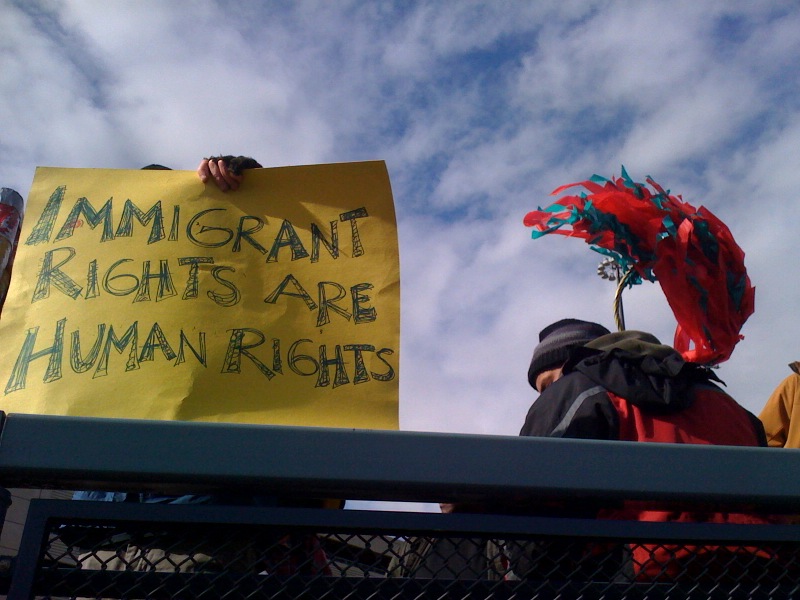
visual activism has played an important role throughout history. From civil rights, labor unions, women’s rights, migrant’s rights and any other injustice we’ve fought for, artists have carried the voice of millions through a single poster, flier or composition of music. Through campaigns such as Alto Arizona, Wordstrike and Soundstrike, artists were able to engage creatively in fighting the unlawful treatment of immigrants. And even though much activism has moved online, the power of the poster is never going away—it’s.

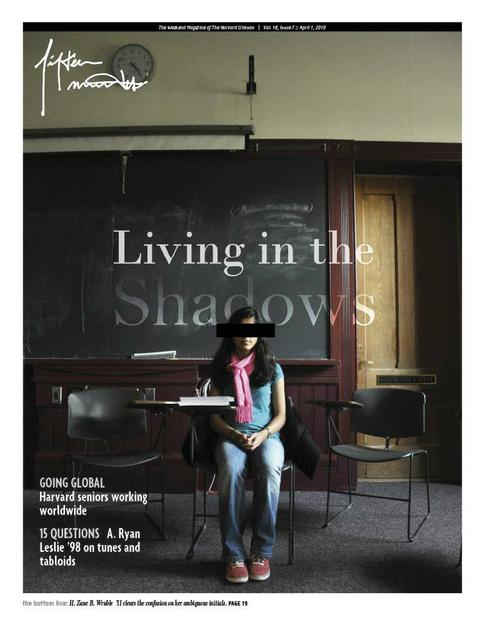
More recently, we see artists coming out to support the DREAM Act. The proposed bill would allow undocumented youth with a clean criminal record who were brought to the country before the age of 16 the right to apply for permanent residency if they commit two years to the military or higher education.


Favianna Rodriguez


Julio Salgado


Santiago Uceda

THE MESSAGE - ABOLISHING DEPORTATIONS & RAIDS